It shipped clean. The code was idiomatic, the tests passed, the pull request had no comments. Your AI coding assistant wrote the auth flow in twelve minutes and it looked correct to everyone who reviewed it — because it was correct, for a threat model that was eighteen months old.
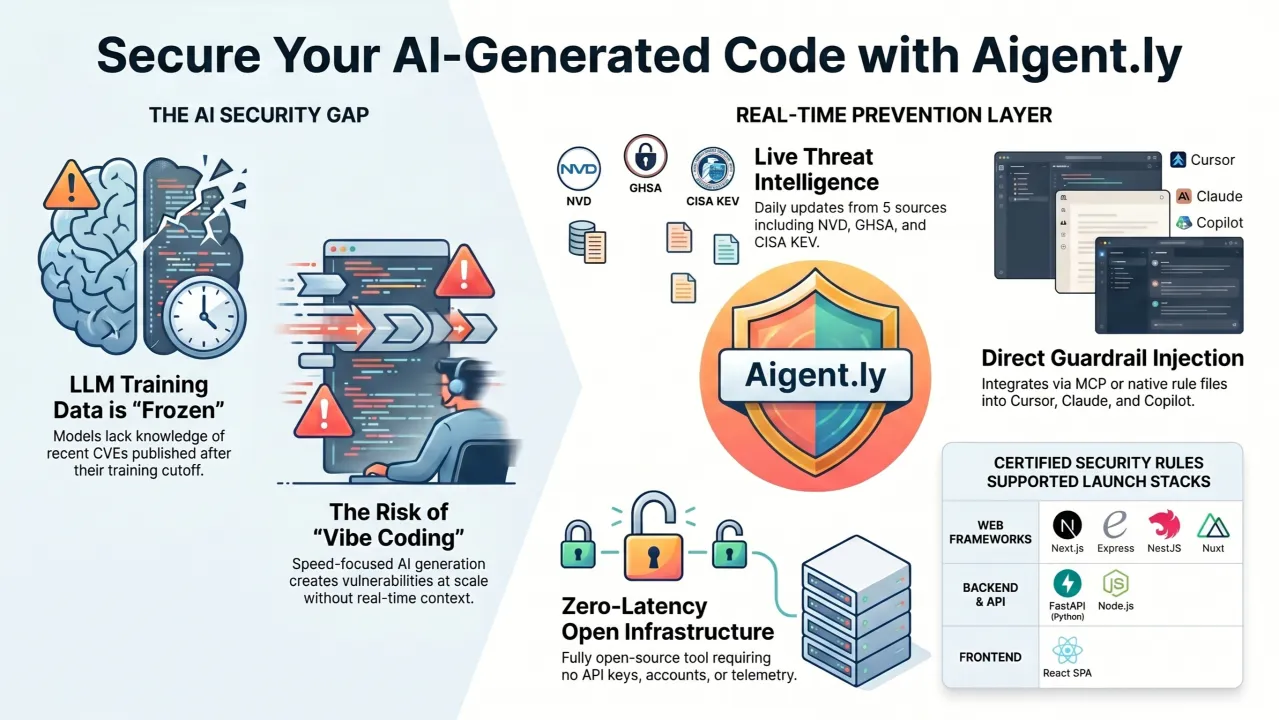
Three weeks before you shipped, a CVE dropped for exactly that pattern. A bypass researchers had been warning about for months finally got a CVE number, a CVSS score, and a CISA advisory telling federal agencies to patch within two weeks. But your AI’s training data was frozen long before that. It had no idea. It wrote what it knew — and what it knew was already exploitable.
This is not a hypothetical failure mode. It is the structural gap at the center of AI-assisted development right now: the tools that make you fastest are also the tools least likely to know what broke last Tuesday.
The Trust Gap Nobody Talks About
When you use Claude Code, Cursor, or Copilot to write security-sensitive code, you are trusting a model trained on a snapshot of the world. That snapshot might be six months old. It might be eighteen months old. The model does not know — and more importantly, it does not tell you when it’s working from stale threat intelligence.
Meanwhile, the CVE pipeline never stops. The National Vulnerability Database, GitHub Security Advisories, CISA’s Known Exploited Vulnerabilities catalog, the OSV database, npm Audit, and EPSS scores are publishing new threats every single day. Attackers study those advisories too. The gap between “CVE published” and “actively exploited in the wild” keeps shrinking.
The result is a strange asymmetry: your AI makes you fast enough to ship features your competitors would take weeks to build, but it also makes you fast enough to ship vulnerabilities your competitors might have caught — because they read last week’s security bulletins.
Speed without current threat context is not acceleration. It is a debt with an unknown due date.
What aigent.ly Does
aigent.ly is a free, open-source MCP server — Model Context Protocol, the standard that lets AI coding tools connect to live data sources — that closes this gap by injecting current security guardrails directly into your coding assistant’s context.
Every time you work in Claude Code, Cursor, Cline, Copilot, or Windsurf with aigent.ly active, your AI has access to rules derived from:
- NVD — National Vulnerability Database
- GHSA — GitHub Security Advisories
- CISA KEV — Known Exploited Vulnerabilities catalog
- OSV — Open Source Vulnerabilities
- npm Audit — package-level vulnerability data
- EPSS scores — exploit prediction scoring, so you know what’s likely to be weaponized next
The database currently tracks 520 verified threats across 11 technology stacks, updated daily by an automated CVE pipeline that commits new advisories as they land.
Your AI does not need to be retrained. It just needs to be told. That is all aigent.ly does — and it is enough.
How It Works in Practice
The architecture is deliberately minimal. aigent.ly generates stack-specific guardrail files — plain markdown documents containing CVE patterns, mitigation guidance, and best practices — that your AI coding assistant reads as context when writing code.
There is no magic. There is no telemetry. The entire system runs locally: the guardrail files live on your machine, the MCP server reads them when your AI asks, and no data leaves your environment.
The setup is a single line in your IDE’s MCP config:
{
  "mcpServers": {
    "aigently": {
      "command": "npx",
      "args": ["-y", "aigently-mcp@latest"]
    }
  }
}
No account. No API key. No onboarding email sequence. It works.
The 11 Stacks It Covers
aigent.ly ships with guardrail support for eleven technology stacks at launch:
| Stack | Ecosystem |
|---|---|
| Next.js | npm |
| Express / Node.js | npm |
| FastAPI / Python | PyPI |
| NestJS | npm |
| Nuxt | npm |
| React SPA | npm |
| Django | PyPI |
| Ruby on Rails | RubyGems |
| Go | Go modules |
| iOS / Swift | Swift Package Manager |
| Android / Kotlin | Maven |
The rules are not generic “write secure code” advice. They are CVE-mapped, stack-specific patterns — the kind of vulnerability that actually shows up in Next.js middleware, that actually gets exploited in FastAPI apps, that actually bit a Rails team last quarter.
The 15 Security Layers
The guardrail system organizes threats into fifteen layers across three tiers. This matters because security debt does not cluster in one place — it spreads.
Core tier — the fundamentals that, when wrong, are catastrophic:
- Authentication & Session — bypass, fixation, credential exposure
- Authorization & Access Control — ownership checks, row-level security, privilege escalation
- Input Validation & Sanitization — injection, path traversal, malformed input
- Secrets & Credentials — hardcoded tokens, leakage vectors
- Dependency & Supply Chain — package pinning, transitive risk
- Data Privacy & Compliance — PII handling, encryption at rest, GDPR patterns
Infrastructure tier — the plumbing that quietly fails under load or misconfiguration:
- API Security & Rate Limiting — throttling, CORS, endpoint authentication
- Database Hardening — RLS, connection pooling, column encryption
- Infrastructure & Deployment — CI/CD secret hygiene, IAM least-privilege
- Caching & CDN — cache poisoning, stale auth data
- Frontend & Network Security — CSP, HTTPS-only cookies, SRI, clickjacking
Operational tier — the layer that only matters after something goes wrong (until it does):
- Observability & Incident Response — log hygiene, audit trails, error boundaries
- Resilience & Recovery — backup strategy, failover, runbook coverage
- AI & LLM Safety — prompt injection defense, LLM output validation, context leakage
- Code Quality & Patterns — error handling, null safety, patterns that prevent vulnerability entry
That last layer — AI & LLM Safety — is worth pausing on. If you are building AI features into your product, aigent.ly covers the threats specific to those features: prompt injection, LLM output validation, context window leakage. The tooling is securing its own attack surface.
Who Actually Benefits
Solo founders shipping SaaS without a security team — aigent.ly is the closest thing to having a staff security engineer reviewing every PR. You will not catch everything, but you will catch the things that end companies.
Junior developers using AI to accelerate their growth — the most dangerous moment for a junior engineer with an AI assistant is when the AI confidently produces a plausible but insecure pattern. aigent.ly makes the AI opinionated about the right patterns.
Senior engineers standardizing AI-assisted development across a team — guardrail files become a shared security baseline. Everyone’s AI is reasoning from the same threat model.
Technical PMs managing AI acceleration programs and dreading the next audit — aigent.ly produces evidence that your AI tooling has security controls. That matters when the SOC 2 auditor asks what guardrails are in place for AI-generated code.
The Uncomfortable Meta-Point
You have already delegated the writing. The question is whether you have also delegated the threat model.
Every team using AI coding assistants at speed has implicitly decided to trust the model’s judgment on security patterns. That trust is mostly warranted — models are good at established, well-documented patterns. But “well-documented” and “current” are not the same thing. The CVE that dropped last Tuesday is well-documented on the NVD. It is not in your AI’s training data.
aigent.ly makes the delegation explicit and then patches the gap. Your AI is still writing the code. It is just writing it with this week’s threat intelligence, not last year’s.
That is not a small thing. It is the difference between shipping fast and shipping fast and safe.
Install It Now
Add this to your IDE’s MCP config and you are done:
{
  "mcpServers": {
    "aigently": {
      "command": "npx",
      "args": ["-y", "aigently-mcp@latest"]
    }
  }
}
Free. Open source. Apache-2.0. No account required. Source on GitHub.
The CVE pipeline runs daily. Your AI’s security context updates automatically. You do not have to do anything else.
AI Fluently covers practical AI patterns, model literacy, and builder stories for engineers shipping AI in production. Subscribe on Substack →