Picture this: it’s 2 AM. Your phone is buzzing. A customer just reported they can see another customer’s private data. Your team scrambles to find the bug — and traces it back to a feature an AI coded in twenty minutes, three months ago, that nobody fully reviewed. The fix isn’t a hotfix. It’s a rewrite. With users watching.
That is not a hypothetical. It is the story of dozens of startups that shipped fast with AI and paid for it later — in breaches, in downtime, in trust they could not rebuild.
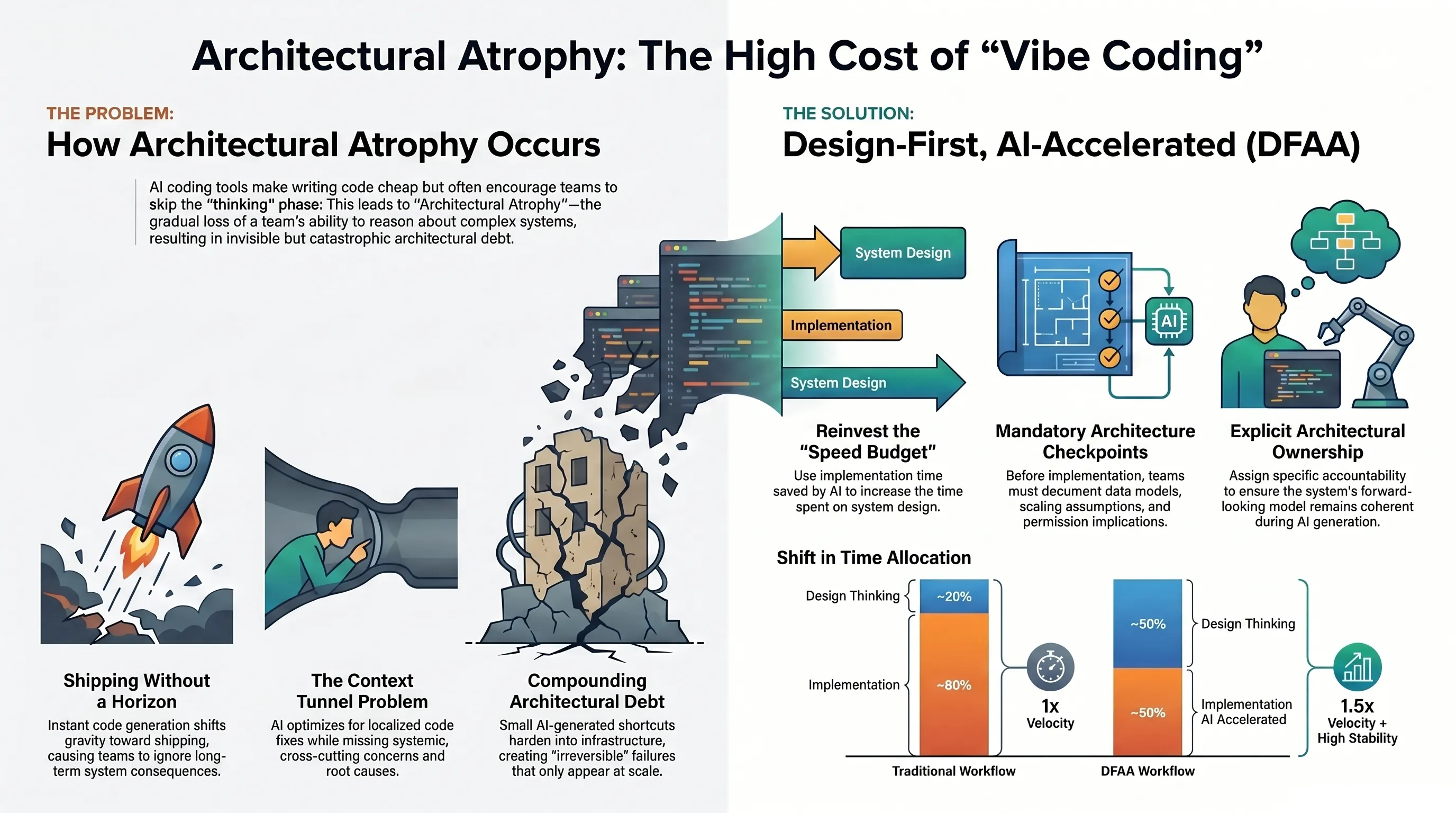
The term Architectural Atrophy describes what happens when teams skip the thinking phase because AI made the building phase so cheap. The design muscle does not break dramatically. It simply stops getting used — until the moment it is urgently, expensively needed.
Two failure modes cause most of the damage.
Pitfall 1: The Feature That Felt Finished
A startup’s engineering team is building a file-sharing feature. The deadline is tight. A developer prompts the AI: “Add file upload, store the file URL in the user record.” The AI generates clean code. It works in testing. It ships on Friday.
What nobody asked — because the code was already running — is: who can access that URL? The AI stored a direct cloud storage link with no expiry, no access check, no authentication. Just a raw URL. Anyone who gets hold of that link can download the file forever — no login required.
Six months later, the startup has 50,000 users and files containing contracts, IDs, and financial documents — all reachable by a permanent public URL. A security researcher finds it. The disclosure goes out. Legal gets involved.
The fix is not patching a line of code. Every file URL in the database must be rotated to signed, expiring URLs. Every client must be updated. Every user notified. A bug that took the AI twenty minutes to write costs the team three weeks and the company its SOC 2 certification timeline.
The design question — how should file access be controlled and for how long? — would have taken ten minutes on a whiteboard. The AI would have implemented the right answer just as fast.
Pitfall 2: The Debug That Dug Deeper
A B2B SaaS team notices their dashboard is getting slow. An engineer pastes the slowest query into Claude and asks for help. Claude spots a missing index, suggests adding it, explains the reasoning clearly. The engineer adds the index, sees a 30% improvement, closes the ticket.
Three months later, the dashboard is slow again — slower than before. This time a different engineer digs deeper and finds the real problem: the entire permission check is running inside a loop. For every row displayed, the app makes a separate database call to verify the user has access. At ten rows, it is ten queries. At a thousand rows — which enterprise customers now have — it is a thousand queries on every page load. The missing index was never the bottleneck. It was never even the problem.
The first AI fix was technically correct for the context it was given. But the context was wrong. Nobody showed the AI the permission model. Nobody asked: what does this query touch at scale? The engineer pasted the symptom, got an answer, and shipped it — because the AI always produces something confident-sounding, and something was enough to close the ticket.
When the real fix finally lands — batching the permission check into a single query — page load drops from 8 seconds to 400 milliseconds. But the team spent two quarters with a slow product, lost two enterprise trials, and now has a backlog of performance complaints from paying customers.
The AI did not fail. The process did. Paste the symptom, get a local fix. Describe the whole system, get the real answer.
What Exceptional Engineers Do Instead
The engineers who build the best systems in the AI era are not the ones who prompt most fluently. They are the ones who think most clearly about what they are building before they build it — and then use AI to build it faster than anyone thought possible.
A simple framework: Design-First, AI-Accelerated (DFAA). AI compresses the cost of implementation. That savings should be reinvested in design time, not extracted as pure velocity. Spend more time asking the hard questions up front — and still ship faster than before.
In practice, three habits prevent most of the damage:
- Before building: answer in one paragraph — what are the security boundaries? What cannot be changed after users have data in it? Then build.
- Before debugging: describe the system to the AI, not just the symptom. Which components does this touch? What does it look like at 10× current load?
- Assign ownership: one person whose job is to ask the uncomfortable question — “have we thought through what happens when this goes wrong?” — before every non-trivial feature ships.
The muscle that must not atrophy is the one that asks: before we build this, have we understood what we are building?
That question is free. It always was. The cost of not asking it has simply never been this high.
AI Fluently covers practical AI patterns, model literacy, and builder stories for engineers shipping AI in production. Subscribe on Substack →